GWAS & Colocalisation for Splice-Switching Targets
Identified shared causal variants between disease and sQTL signals to support therapeutic candidate selection for a splicing-focused biotech client.
A therapeutics client developing splice-switching oligonucleotides engaged Doppeldata to put their target-selection decisions on a rigorous statistical footing. Before committing significant lab resources, they needed to know whether the genetic signals pointing at their candidate genes were real and disease-relevant — or a statistical coincidence.
- Delivered a tiered confidence ranking of every candidate target within the engagement window
- Confirmed genuine causal support for a subset of targets and deprioritised others before lab work began
- Gave the team a statistically defensible basis for target selection they could take to investors and collaborators
The Challenge
The client needed to confirm that candidate splice-QTL (sQTL) signals in their target genes were driven by the same underlying causal variant as the associated disease GWAS signal — not two independent, coincidentally overlapping associations. Overlapping association is not the same as shared causality, and getting this wrong risks pursuing a splicing mechanism with no real link to disease risk.
Key objectives:
- Establish whether each candidate target’s sQTL signal genuinely colocalised with the disease signal
- Rule out expression-driven confounding that could masquerade as a splicing effect
- Produce a ranked, evidence-backed shortlist to focus experimental resources
The Approach
The engagement followed a staged analysis designed to move from raw signals to a defensible target ranking:
Signal mapping
Mapped sQTL signals across relevant tissue types for each candidate target gene, establishing where and how strongly splicing was genetically regulated.
Statistical colocalisation
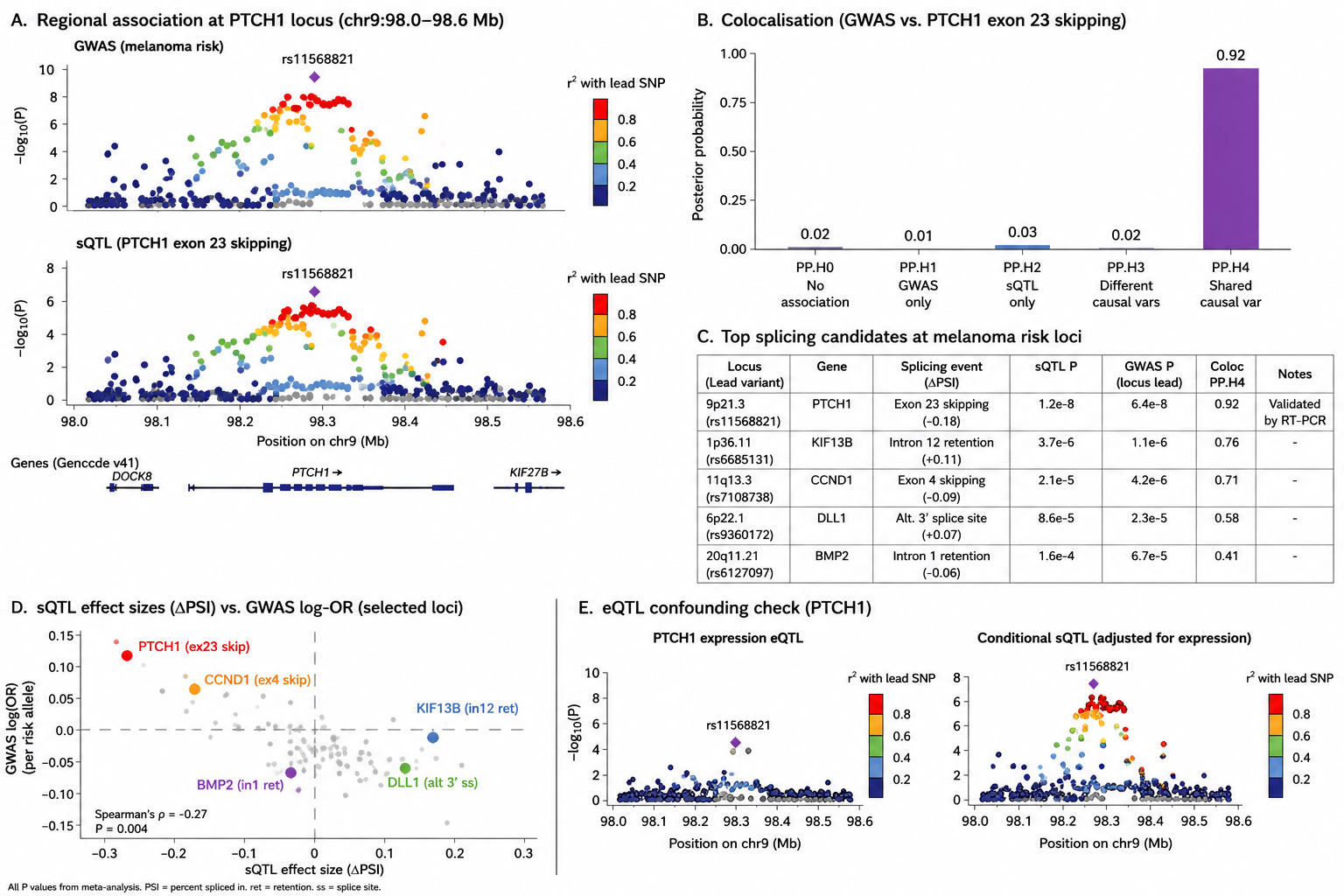
Ran formal colocalisation analysis between GWAS summary statistics and sQTL data to test, target by target, whether a single shared causal variant drove both signals.
Confounding checks
Cross-checked results against independent eQTL data to rule out expression-driven confounding, so a splicing conclusion couldn't be an expression effect in disguise.
The Results
- Confirmed strong colocalisation evidence for a subset of candidate targets, deprioritising others before further lab work began
- Gave the client a statistically defensible basis for target selection, reducing downstream experimental risk
- Findings directly informed prioritisation of splice-switching oligonucleotide development
Why It Mattered
Colocalisation analysis is easy to get wrong — overlapping association doesn’t mean shared causality. A statistical genetics background applied specifically to this problem meant the client could move forward on targets with genuine causal support, rather than discovering the gap after committing lab resources.

Bioinformatics, statistical genomics & computational biology - practical tools, learning resources, and expert guidance based in South Australia. We are a community that believes in accessible knowledge and learning together.