Variant Annotation & ACMG Classification Workflow
Reproducible variant annotation and ACMG-guided classification workflow to support clinical interpretation of sequencing results.
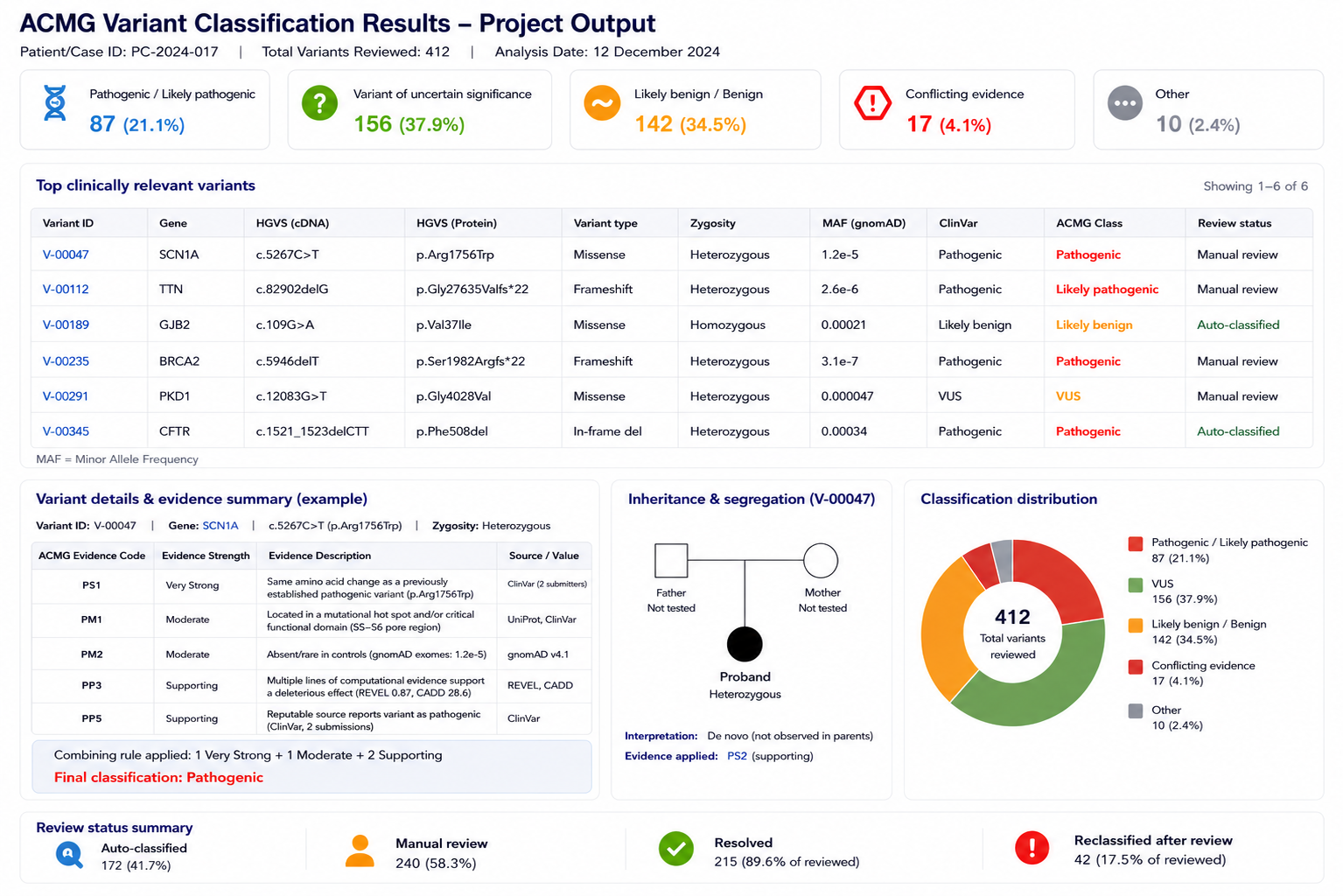
A clinical sequencing laboratory engaged Doppeldata to bring rigour and repeatability to how it classified variants under the ACMG/AMP framework. The lab’s analysts were classifying every variant by hand - pulling population frequencies, computing in-silico predictions, and searching ClinVar case by case - and the same variant could receive slightly different evidence codes depending on who reviewed it and when. The goal was to encode the framework itself into the workflow, so the evidence gathering was automatic and the classification logic was applied identically every time.
- Automated the evidence-gathering behind every ACMG/AMP criterion - frequency, computational, and prior-classification codes assigned before an analyst opened the case
- Encoded the Richards et al. combining rules so pathogenic / likely-pathogenic / VUS / benign calls were derived identically across analysts
- Focused human effort on the variants that genuinely needed it - the VUS and conflicting-evidence cases - by auto-resolving the clear-cut ones
- Produced a per-variant evidence record listing every code applied and the data behind it, ready for internal review and re-classification over time
The Challenge
The ACMG/AMP guidelines (Richards et al., 2015) define classification as a structured accumulation of evidence: population-frequency codes (BA1, BS1, PM2), computational and predictive codes (PVS1 for predicted loss-of-function, PP3/BP4 from in-silico predictors), functional and segregation evidence, and prior-classification evidence from sources like ClinVar. Each code carries a strength (very strong, strong, moderate, supporting), and a defined combining rule turns the accumulated codes into a five-tier call.
Applied by hand, this is slow and drifts. Two analysts can reasonably disagree on whether PM2 (absence from population databases) applies at a given frequency threshold, or whether PP3 is warranted from a borderline in-silico score - and those small differences propagate into different final classifications. The lab needed the evidence collection to be automatic and the combining logic to be deterministic, while keeping the genuinely judgement-heavy calls in expert hands.
Key objectives:
- Automate assignment of the mechanical ACMG/AMP codes (frequency, computational, prior-classification) from authoritative data sources
- Apply the Richards et al. combining rules deterministically so identical evidence always yields an identical call
- Separate variants that can be confidently auto-classified from those requiring expert review, rather than treating every variant as manual
- Capture the full evidence trail so any classification can be audited and revisited as databases evolve
The Approach
The workflow encoded the framework as a pipeline - gathering evidence, applying codes, combining them, and surfacing what needed a human - rather than leaving each step to manual judgement.
Evidence annotation
Annotated every variant against gnomAD for population frequency, ClinVar for prior clinical assertions, and in-silico predictors (REVEL for missense, SpliceAI for splice-region variants), plus consequence prediction to flag predicted loss-of-function. This assembled the raw evidence each ACMG/AMP code depends on before any classification logic ran.
Criterion assignment
Encoded the individual ACMG/AMP criteria as explicit rules - BA1/BS1/PM2 from frequency thresholds, PVS1 for predicted null variants in appropriate genes, PP3/BP4 from calibrated in-silico score cut-offs, PP5/BP6 from ClinVar assertions - so each applicable code, and its strength, was assigned consistently rather than by recollection.
Deterministic combining
Applied the Richards et al. combining rules to turn the accumulated codes into a five-tier call (pathogenic, likely pathogenic, VUS, likely benign, benign). Variants meeting the criteria for a confident call were auto-classified; variants with sparse or conflicting evidence were routed to expert review rather than forced into a tier.
Evidence record & reclassification
Wrote out a per-variant record listing every code applied, its strength, and the underlying data value - the frequency, the predictor score, the ClinVar accession. Because the evidence was captured explicitly, a variant could be transparently re-classified later when gnomAD, ClinVar, or predictor calibrations changed, without re-deriving it from scratch.
The Results
- Evidence gathering that previously took an analyst several minutes per variant was assembled automatically, so review started from a fully-annotated, pre-coded case
- Identical evidence produced identical classifications regardless of analyst, removing the drift inherent in manual code assignment
- Clear-cut benign variants (high population frequency, BA1) and unambiguous pathogenic variants were auto-classified, concentrating expert time on the VUS and conflicting-evidence cases where judgement actually adds value
- Every classification carried a complete, machine-readable evidence trail - the foundation for defensible reporting and for systematic re-classification as the underlying databases evolve

Why It Mattered
Under ACMG/AMP, a classification is only as trustworthy as the consistency of the evidence behind it - and manual interpretation quietly erodes that consistency. Encoding the criteria and the combining rules meant the mechanical parts of classification were deterministic and auditable, while expert judgement was reserved for the variants that genuinely required it. Just as importantly, capturing the evidence explicitly turned classification from a one-time verdict into something that could be revisited: as ClinVar assertions accumulate and population databases grow, a VUS today may become classifiable tomorrow, and the workflow was built to make that reassessment routine rather than a manual re-investigation.
Bioinformatics, statistical genomics & computational biology - practical tools, learning resources, and expert guidance based in South Australia. We are a community that believes in accessible knowledge and learning together.