Whole Genome Sequencing Variant Interpretation
Built an annotation, filtering, and clinical significance tiering pipeline for WGS results delivered through the Doppeldata kit program.
Whole genome sequencing results generated through the Doppeldata kit program needed a clear, repeatable path from raw variant calls to a report a non-specialist could actually understand — without losing scientific rigour along the way.
- Delivered one consistent, repeatable interpretation pipeline usable across every kit participant
- Reduced per-genome manual review by filtering out benign background variation upfront
- Produced reports participants could understand without a genetics background
The Challenge
WGS results needed a clear, repeatable path from raw variant calls to an understandable report — annotated, filtered, and tiered by clinical significance, without losing scientific rigour. Manual, case-by-case interpretation didn’t scale across every kit participant.
Key objectives:
- Turn raw variant calls into a consistent, tiered interpretation
- Separate meaningful signal from the vast benign background variation in any genome
- Produce reports understandable by a general audience without oversimplifying
The Approach
The pipeline moved from raw calls to participant-ready report in defined stages:
Annotation
Built an annotation layer combining functional consequence, population frequency and known clinical significance onto every raw variant call.
Filtering & tiering
Applied filtering rules to separate signal from the enormous volume of benign background variation, then tiered remaining variants by clinical significance to prioritise what warranted attention.
Validation checks
Built in concordance and sanity checks against known benchmark variants, so the pipeline's tiering could be trusted before any report was generated.
Reporting
Structured the output into a report format suitable for a general audience without oversimplifying the underlying evidence.
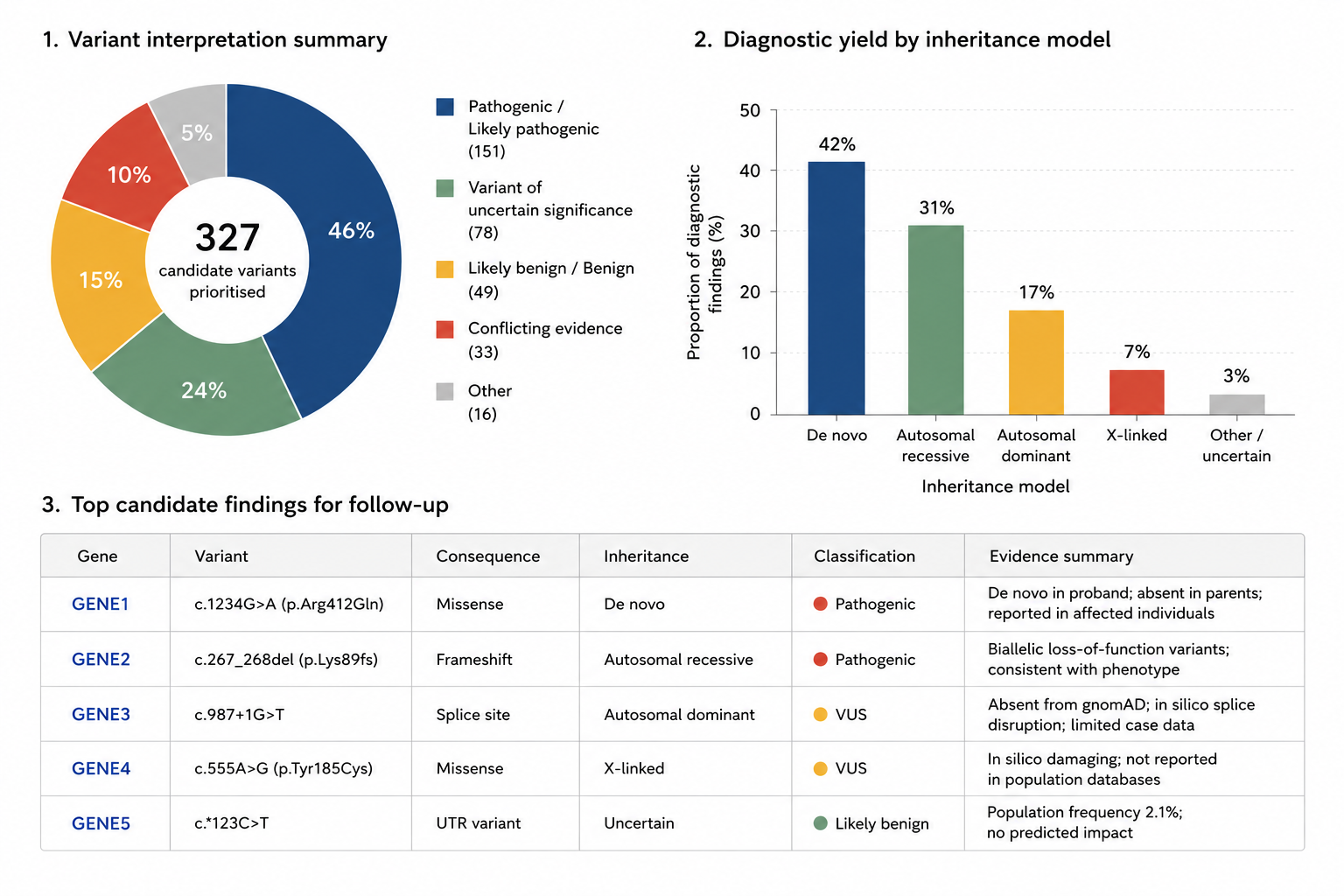
The Results
- Delivered a consistent, repeatable interpretation pipeline usable across every kit participant’s results
- Reduced the manual review burden per genome by filtering out non-significant variation upfront
- Produced reports that participants could understand without a genetics background
Why It Mattered
Sequencing is the easy part — interpretation is where genuine value gets created or lost. A structured, tiered pipeline meant every participant received a consistent standard of interpretation, not something dependent on manual review quality on a given day.

Bioinformatics, statistical genomics & computational biology - practical tools, learning resources, and expert guidance based in South Australia. We are a community that believes in accessible knowledge and learning together.